Dog Training
Basic obedience of the Dog Aggressive Canine
May
Basic Obedience – disclaimer
In all my years of working with and training dogs, I have never owned or trained a Bull Breed, so I don’t profess to be an expert with them in any way, Springers are my area of expertise. However, the dog in this blog was amazingly responsive to this technique and the best I gained from the whole situation was that she was impeccably well trained after I did some intensive basic obedience with her.
Control and manners were the key
The purpose of this disclaimer is to say this is OUR STORY and our story only, but what I will say is that basic obedience has never failed me. It is the one thing that most dogs lack. The basic obedience I write about in this blog has not cured this dogs’ aggression, what it has done is made sure that when I ask her to come, wait or sit or stay, she does it without delay. She has respect for me and knows her place in the pack. Please read bearing the above in mind and hope that the blog helps you in some way.
Nala’s history
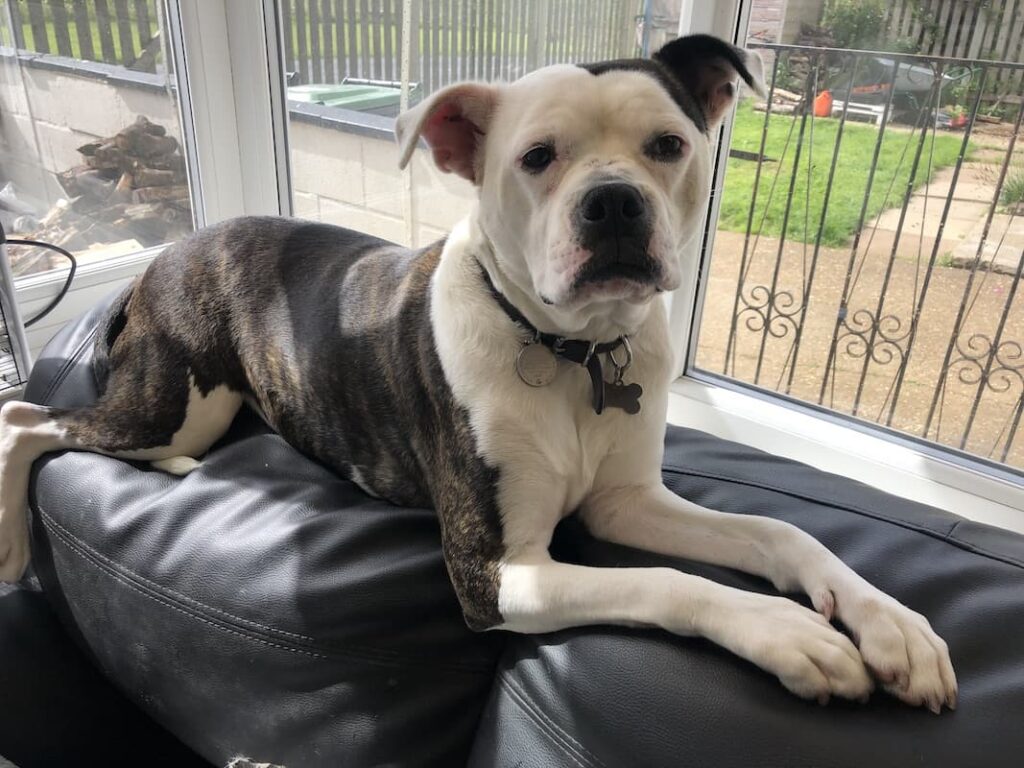
Nala was free to a good home on Facebook, rescued by a kind group concerned for her welfare and handed over to a rescue, she was about 7 months old at this point and suspected to be an American Bulldog cross Staffy. She came with just a collar and a lead and this is where our story began. Needless to say, Meg K9 kitted her out and I’d say my most valuable tool was the dog training lead.
Road traffic accident while still a puppy
We had no real history but we did know that she had a pinned leg – suspected RTA at around 5 months of age. I fostered for said rescue and ended up keeping her. She doesn’t have any problems with her back legs, sometimes a little lame but overall a very happy little dog. Beautiful nature and initially amazing with all of my dogs and great with people and still is.
Over the months she lived with my pack, however pre-walk excitement started to become a problem. Ears were getting nipped and what looked like minor playful borderline aggression started to show. We had her neutered after consulting with the vet 9 weeks after her first season. It didn’t change anything. I’m not saying I regret this, she would have been neutered anyway as should all bitches (my opinion).
Then the aggression started
As the weeks went on, she started attacking my dogs, mainly the lower pack members or smaller dogs. There came a point where this could not continue and she had to be separated. She was still friends with Top, one of the other rescues (a large dog) and Marley, one of mine and again a large dog. She was still friends with little Breeze the Spaniel… until…
The final straw
The final straw was when she attacked a customers dog. She was on a short lead but not muzzled. I thought on lead was enough to control her but in this case, it wasn’t. It wasn’t pretty but not too bad. 2 puncture wounds about 1.5cm across on the back of the neck that didn’t heal too well as the dog kept shaking its’ head due to ear problems. We took him to the vets and all was well. The customer returned and was alright with the situation.
We nearly said goodbye that weekend, but as the hours went on, I knew I simply could not do it.
Basic obedience of the dog aggressive canine
I had been doing obedience with her before this incident, but it was apparent that basic obedience was never going to be a cure, it would just improve control. The end result was she was not allowed to mix with any other dog apart from Top, he was her only friend.
Update Spring/Summer 2019: she is allowed out with all of my dogs and does really well. She has even made a huge amount of progress in the situations that previously triggered her.
The aftermath following a serious incident
An interesting but sad thing happened after this incident. Breeze – her best friend, saw her attack my customers’ dog. I still used to walk her with Top and Breeze albeit muzzled but one morning, Breeze attacked her quite savagely, for a Springer I was shocked.
She made a mess of her ear and tore a hole in her leg. It wasn’t that bad by the next day, just a bit of soreness on her ear and a clean puncture wound on her leg. She was unphased by it all. And if that wasn’t enough, our new girl – Maisie fed off Breeze’s behaviour and she also does not like her now. So I have 3 bitches who cannot mix (Breeze and Maisie are now best friends).
So where are we now? She lives on her own but mixes with Top on walks. She’s a naturally solitary animal as she shows no signs of worry and is by all accounts a very happy go lucky little girl.
Basic Obedience
- THE RECALL (a competitive obedience style recall – from a sit-stay to present in front and then round to the side in a sit at heel, which means you have an informal recall whenever you need it)
- SIT STAY
- WALK TO HEEL (again, competitive obedience style heelwork)
- Distance control (sit) of about 50 metres
The Recall
It’s all here in my other Blog. Teaching your dog to come when called.
The Sit
Do I need to teach you how to teach a dog to sit? OK, the difference is this is a reliable sit, asked for once, responded to immediately and the dog stays there until you give the release command (I use ‘OK’). I won’t go through actual teaching of the sit as that’s easy but what I will do is just give you some tips.
- Ask once, speak clearly
- Your command can be anything, even a sentence if your dog is particularly switched on, but the less words the better. Use ‘sit’ if you’re not sure.
- Assuming you are using the lure method (treat or toy in hand raised up – bottom down), phase out your lure, the hand gesture you have just used (raising hand) becomes an empty hand and the treat/toy reward becomes a verbal and/or physical reward.
- Use a gesture for every command, hand signal, call it what you want (it will come in handy when your dog loses its hearing – all my dogs respond to hand signals and head nods for directional commands, for example, go that way, come this way, over here, get out the way etc)
- Stand up straight, don’t lean over, this becomes part of the visual cue for the behaviour
- Be firm but kind, don’t lose your rag, if you do, quit and apologise to your dog! Start again with a better attitude!
- Be assertive – mean what you say. Don’t fanny about.
Sit, wait & stay
- Continue with sit training, add a flat palm signalling STAY THERE!
- Release & praise
- Repeat flat palm (your new hand gesture/hand signal)
Phase 2
- Sit command, flat palm “stay!” take one step back then step back in. Reward.
- Repeat.
Phase 3
- … jumps ahead … At the stage where you are teaching a sit-stay DO NOT EVER RECALL YOUR DOG. This is saved for the fully trained sit-stay, you never call your dog from a sit-stay while they are in training as they will predict your call and break the stay.
- It is a slow process but obviously depends on your skill and the dogs’ trainability.
- Stepping away is done tentatively and you ALWAYS RETURN TO THE DOG.
- Don’t work too fast, always be mindful you need your dog to succeed to learn, success gives more opportunity to learn.
- Difficulty levels include walking around your dog, moving further away, moving your arms (i.e. increasing distractions) etc.
- NEVER EVER increase the difficulty beyond what your dog can succeed at. Training is all about managing success and helping your dog to get it right. This omits the requirement for punishment, not that I think there is any place for punishment in dog training as dogs will never ‘actually learn’ a behaviour from being bollocked for doing the wrong thing.
Final Phase – Putting the recall and sit-stay together
- Do you feel you are at the stage now where your dogs sit-stay is reliable? It may be some time down the line. Still, keep reinforcing the sit-stay WITHOUT a recall to keep this behaviour nicely reinforced.
Heelwork
Granted, this method works better with dogs who can be easily lured with food. Dogs who are more easily distracted or difficult to motivate are beyond the scope of this blog – sorry.
- Do this exercise when you aren’t going anywhere, this is purely a training exercise although you can practice it anywhere as long as you are both focussed and not disturbed by distractions.
- Dog starting point, is front present (dog sits facing you) take your food lure and guide dog to the left behind your legs, the aim is for dogs bum to work independently swinging out and round, the dog comes to your side in a straight line, bum does not swing out to the left. Food treat is your cue/gesture, which is now placed on your left hip. Not easy without a video which I will post in due course.
- Repeat.
- The heelwork is a progression of this exercise. Once the dog is at your side, you will take one step forward.
- Skills your dog will acquire – front moves independently of the rear, they learn to bend in the middle!
Meg K9 Dog Leads makes leads and walking aids to help with many dog training issues, they are as follows:
SIMPLE LEADER DOG HEADCOLLAR or Dream Walker fits over your dogs head like a horses head collar, adds control to your dog walks.
DOG TRAINING LEAD You can’t teach a recall without a dog training lead. Why? Because as your dog chooses to do his own thing, where is your control? There is none.
Update on Nala October 2019
So, Nala is a house dog again \o/ Yay! I was pushed into this because a) I didn’t want to heat the kennel block just for her and b) the muzzle was causing some sores on the bridge of her nose.
She lives in the conservatory happily with dogs passing her (unmuzzled). I have had some new wooden stair gates fitted so that helps with pack management and segregating Nala when I think the risks are higher.
I have also figured out why she was aggressive, what triggers it and how to avoid it. I have watched Nala very closely and back when she was a young adolescent, she was trying to calm the packs’ arousal pre-walk (she was trying to bring some order to the rowdy situation), but she wasn’t doing a very good job and it was escalating to high arousal state which involved bites and other dogs becoming anxious.
The realisation of why she does that also became apparent in the office when Jasper stole something and I was trying to get it off him. He was being a growly dick and not letting go then Nala lunged at him (no bite, although she was muzzled) and I interpreted this as ‘stop it you stupid floppy-eared Spaniel and do as you’re bloody told’.
The obedience work I did with her has been my saving grace. I identify the times when she triggers and make her sit and wait (muzzled), then release with ‘OK’. This happens at the back door pre-walk and the back gate going out into the paddock.
Update 2020
Unfortunately, there have been a couple of incidents with Nala being central to these. It all starts with arousal, so rushing around, pre-walk excitement, fence running, that kind of thing. As hard as I try to limit occurrences, there are always times when it’s just an accident, but it doesn’t stop me being on guard all of the time.
Update August 2023
Since writing this blog, I can admit to having probably at least three serious incidents involving Nala and another one of my bitches. It’s 6 and 2 threes really as to who was to blame, but ultimately, I blame myself for allowing it to happen.
Update June 2024
Wow, what a difference. Nala is a different dog. It’s been a long training road, but I think we can finally say we’ve cracked it with our dog training.
Take home message
I think this proves that training your dog from an early age to learn basic obedience principles can give you multiple benefits. The benefits of training your dog are numerous and you won’t be disappointed.
Keep an eye out for our heel walking series, which we hope will include:
- heel walking
- teaching your dog to accept a head collar
- heelwork using a head collar